10 Signs Your Business Website Needs a Redesign
Your website is often the first place potential customers interact with your business. Before they call, request a quote, or visit your location, they may check your website to decide whether your business is trustworthy and worth their time.
But an outdated, slow, or difficult-to-use website can quickly turn potential customers away.
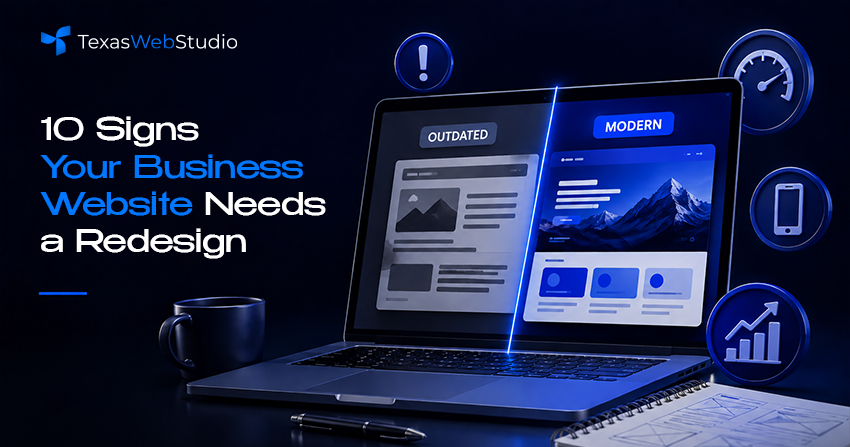
If your website hasn’t been updated in several years, it may be time to consider a redesign. Here are 10 signs your business website needs a redesign.
1. Your Website Looks Outdated
Web design trends, technology, and customer expectations change quickly. A website that looked modern several years ago may now make your business appear outdated.
An old-fashioned design can affect how visitors perceive your brand. Outdated layouts, small text, low-quality images, inconsistent colors, and cluttered pages can make it harder for users to trust your business.
A modern website should have a clean layout, professional visuals, easy-to-read content, and a design that reflects your current brand.
2. Your Website Isn't Mobile-Friendly
A large portion of website visitors browse from smartphones and tablets. If your website doesn’t work properly on smaller screens, you’re potentially losing customers.
A mobile-friendly website should automatically adjust to different screen sizes. Visitors should be able to read your content, navigate menus, click buttons, and complete forms without constantly zooming or scrolling sideways.
If your website looks good on a desktop but is difficult to use on a phone, a redesign should be a priority.
Then create content that satisfies the same search intent—but provides more value.
3. Your Website Loads Too Slowly
Website speed has a major impact on user experience. Visitors don’t want to wait around for pages, images, or menus to load.
Slow websites can lead to higher bounce rates and fewer conversions. Common causes include oversized images, outdated plugins, poor hosting, unnecessary scripts, and inefficient website code.
During a redesign, your website can be optimized for better performance by compressing images, improving the site’s code, reducing unnecessary elements, and using modern web technologies.
4. Your Website Isn't Generating Leads or Sales
Your website shouldn’t simply look good—it should help your business generate results.
If visitors are coming to your website but aren’t calling, submitting forms, requesting quotes, or making purchases, there may be a problem with your conversion strategy.
A website redesign gives you an opportunity to create clear paths that guide visitors toward taking action.
5. Your Website Is Difficult to Navigate
Imagine a potential customer visiting your website but struggling to find your services, pricing information, contact details, or location.
They may simply leave and choose a competitor.
Your website navigation should be simple and intuitive. Visitors should be able to understand what your business offers and find important information with minimal effort.
A redesign can improve your website structure, navigation menus, page hierarchy, and internal links so users can move through your site more easily.
6. Your Website Content Is Outdated
Businesses change over time. You may have added new services, changed your location, updated your team, or modified the way you work.
If your website still contains old information, it can create confusion and reduce customer trust.
Check whether your website has:
A redesign is a good opportunity to review your content and make sure everything accurately represents your business today.
7. Your Website Isn't Ranking Well on Google
A visually attractive website isn’t enough if potential customers can’t find it through search engines.
Poor rankings can result from several issues, including weak keyword targeting, poor site structure, slow loading speeds, missing metadata, technical SEO problems, and a lack of useful content.
A website redesign can incorporate SEO-friendly architecture from the beginning.
This can include optimizing page titles, headings, URLs, internal linking, content structure, image optimization, and other technical elements.
For businesses targeting local customers, local SEO should also be considered as part of the redesign strategy.
A responsive website should provide a good experience across different screen sizes.
8. Your Branding Is Inconsistent
Your website should feel like a natural extension of your brand.
If your website uses different colors, fonts, logos, imagery, or messaging than your social media profiles, advertisements, business cards, or other marketing materials, your brand may appear inconsistent.
A redesign allows you to create a consistent visual identity across your digital presence.
Consistent branding can make your business look more professional and help customers recognize your company across different platforms.
9. Your Website Isn't Secure
Website security is essential for protecting your business and your customers.
If your website doesn’t use HTTPS or relies on outdated software, themes, plugins, or frameworks, it may be vulnerable to security problems.
Security issues can also damage customer trust. Visitors expect businesses to take their information and privacy seriously.
During a redesign, your development team can review the site’s technology, update outdated components, implement security best practices, and make sure the website is built on a reliable foundation.
10. Your Website Is Difficult to Update or Manage
If changing a phone number, adding a service, or updating a page requires extensive technical work every time, your website may be using outdated technology or an unnecessarily complicated setup.
A modern website should make routine updates easier.
Depending on your business needs, a redesign can provide a more manageable content management system, better page organization, and a scalable structure that allows your website to grow with your business.
How a Website Redesign Can Help Your Business
A professional website redesign isn’t simply about changing colors or making your homepage look different.
A strategic redesign can improve both the customer experience and your business performance.
It can help you:
The goal should be to create a website that works as a business growth tool, rather than simply an online brochure.
When Should You Redesign Your Website?
There isn’t a universal rule that says every business must redesign its website after a specific number of years.
Instead, look at your website’s performance and your business goals.
A redesign may be worth considering if:
If one or more of these problems sound familiar, a website audit can help determine whether you need a complete redesign or targeted improvements.
Website Redesign Checklist
Before launching a redesigned website, make sure it includes:
Conclusion
Your business website plays an important role in how potential customers discover, evaluate, and interact with your company.
If your website looks outdated, loads slowly, is difficult to navigate, isn’t mobile-friendly, or fails to generate leads, it may be time for a redesign.
A modern website should do more than look professional. It should provide a great user experience, support your SEO strategy, build trust, and help turn visitors into customers.
If you’re unsure whether your current website needs a complete redesign, start with a professional website audit. Identifying the biggest problems first can help you make smarter decisions about your website and your digital marketing strategy.